


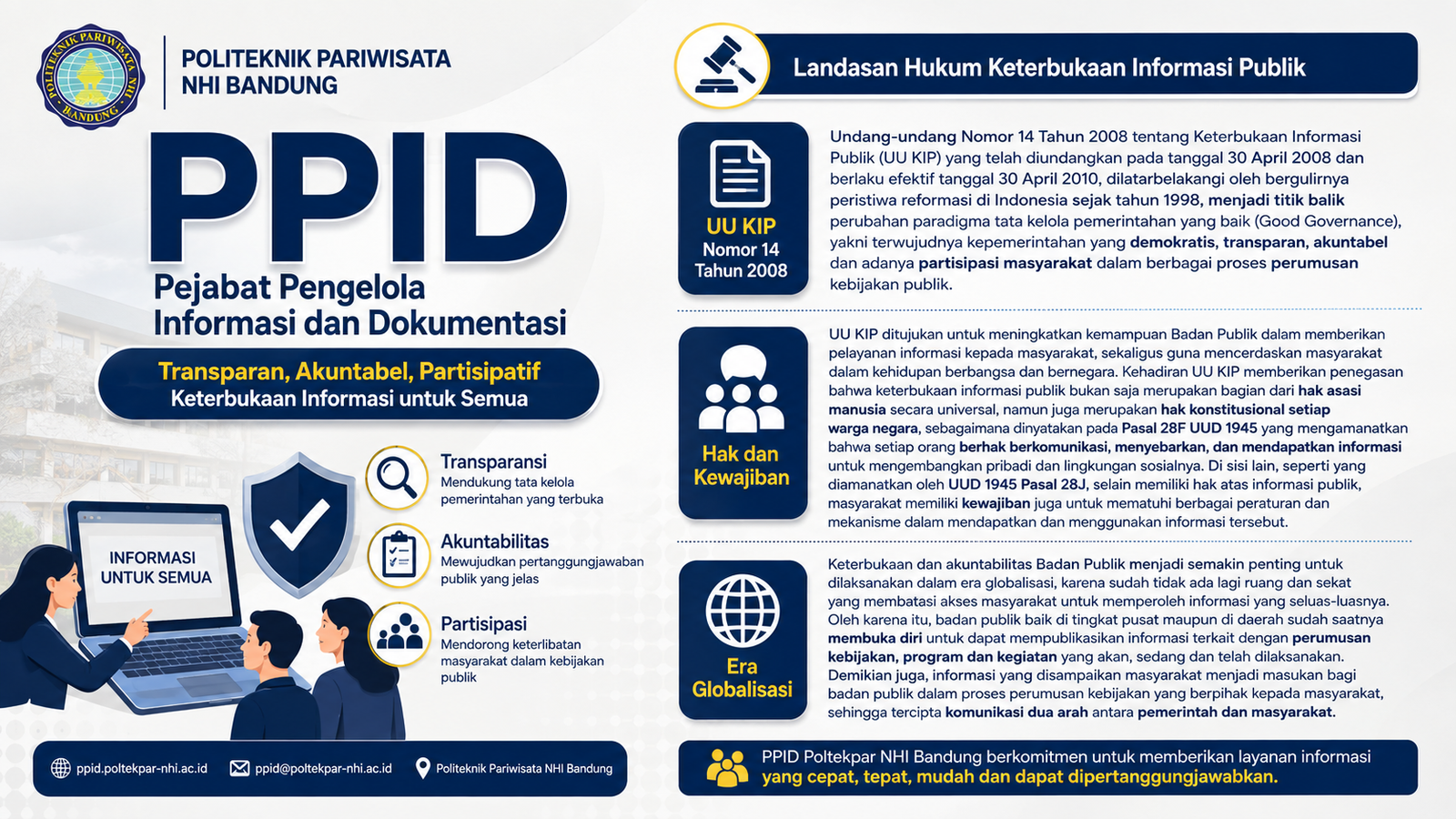
Law Number 14 of 2008 concerning Public Information Disclosure (Public Information Disclosure Law/UU KIP) represents one of the important milestones in realizing good governance in Indonesia. The Public Information Disclosure Law was enacted on April 30, 2008, and came into full effect on April 30, 2010. Its establishment cannot be separated from the spirit of reform that emerged in 1998, which brought about a paradigm shift in government administration toward democratic, transparent, and accountable governance, while encouraging public participation in the public policy-making process.
The Public Information Disclosure Law aims to improve the quality of information services provided by Public Bodies while encouraging the public to become more informed, critical, and actively engaged in national and civic life. Public information disclosure is not only part of human rights but also a constitutional right of every citizen, as affirmed in Article 28F of the 1945 Constitution of the Republic of Indonesia. Everyone has the right to communicate, obtain, store, process, and convey information through various available channels in order to develop themselves and their social environment. Nevertheless, the right to information must also be accompanied by the responsibility to comply with the applicable provisions, procedures, and mechanisms in obtaining and using public information.
In its implementation, public information disclosure within Public Bodies is supported by the existence of the Information and Documentation Management Officer (Pejabat Pengelola Informasi dan Dokumentasi/PPID). The PPID is an official responsible for managing and providing public information, including the storage, documentation, provision, and delivery of information to the public. The PPID also plays an important role in ensuring that public information is managed in an orderly manner, is easily accessible, accurate, and compliant with applicable laws and regulations.
Through the PPID, the public has a clear channel for obtaining public information from Public Bodies. The PPID coordinates the collection and documentation of information, provides information that is required to be publicly disclosed as well as information that may be provided upon request, and handles public information requests in accordance with applicable procedures. Thus, the PPID constitutes an important element in establishing information services that are transparent, professional, responsive, and accountable.
In the era of globalization and rapid developments in information technology, transparency and accountability within Public Bodies have become increasingly important. The ease of access to information has removed many limitations of space and time, enabling the public to obtain information more quickly and extensively. Therefore, Public Bodies are expected to become increasingly open in providing and communicating information regarding policies, programs, activities, and achievements that have been, are being, or will be implemented.
At the same time, information disclosure provides opportunities for the public to express aspirations, provide input, and offer feedback that can serve as considerations in the formulation of public policies. Thus, public information disclosure is not merely a means of fulfilling the public’s right to information, but also serves as an instrument for establishing two-way communication between Public Bodies and the public, strengthening public trust, and realizing governance that is transparent, accountable, responsive, and participatory.
In the context of Politeknik Pariwisata NHI Bandung, the PPID serves as part of the institution’s commitment to realizing public information disclosure through information and documentation management that is well-planned, orderly, easily accessible, and oriented toward public needs. The PPID of Politeknik Pariwisata NHI Bandung strives to provide information services that are prompt, accurate, accessible, transparent, and accountable, while also supporting the realization of good and trustworthy higher education governance.